The Five Skills a Faceless YouTube Channel Actually Runs On
For a long time I assumed that earning anything from YouTube required a good camera face, an easy speaking voice, and a willingness to be recognised in public. Then I started paying attention to how many channels pass a million views without their owner ever appearing on screen.
That is the faceless model, and its appeal is obvious if you are introverted, uncomfortable on camera, or simply want to build something that does not depend on you being available to film. What is less obvious is that it does not remove the work. It relocates it.
A faceless channel runs on five skills. None of them are talents. All of them are learnable in weeks, and the weakest one is what will hold you back – not the one you enjoy practising.
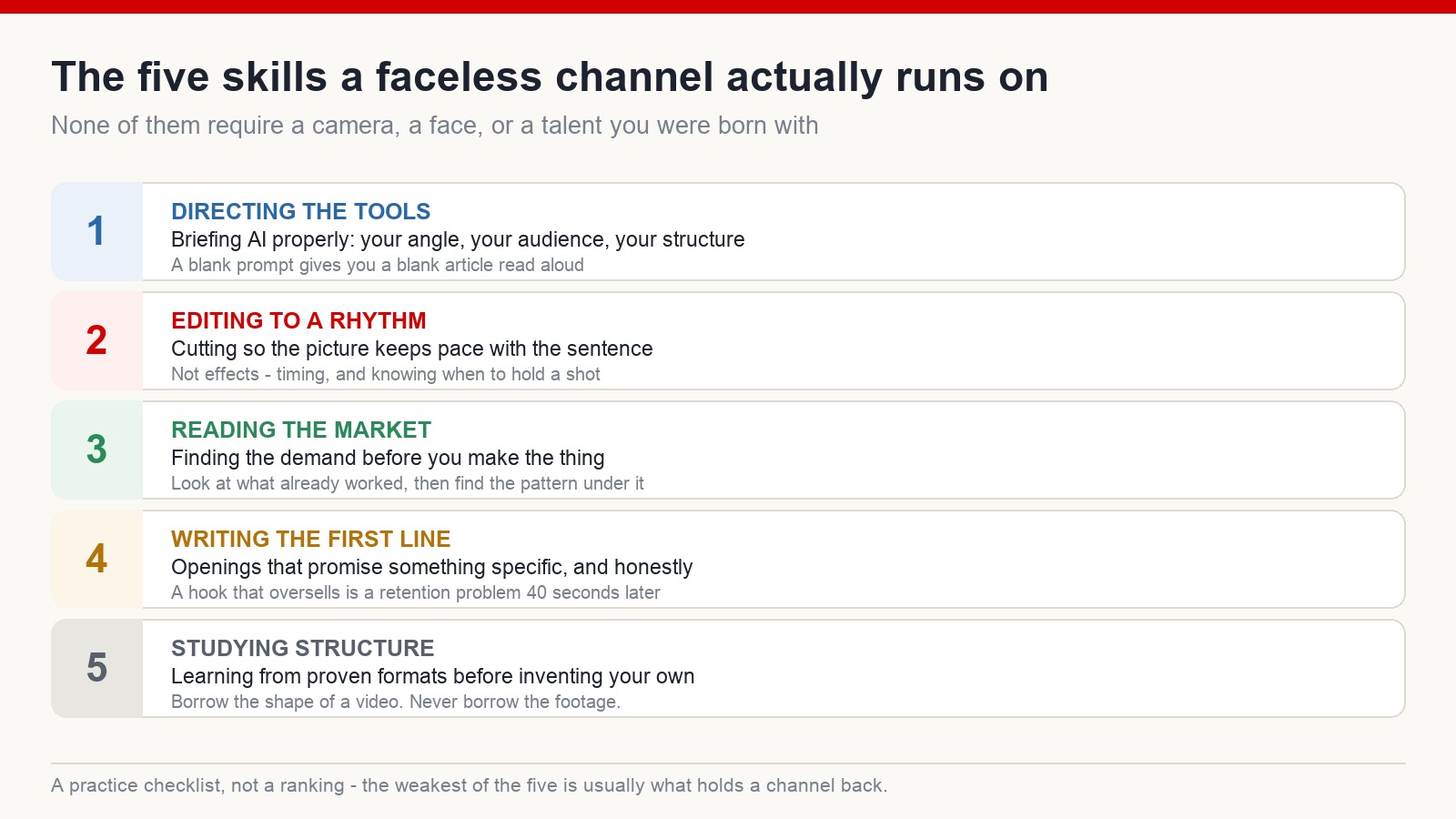
I have been making videos since 2017, mostly faceless channels aimed at viewers in the US, the UK, Germany and Japan, and this is the order I would learn them in.
1. Directing the tools, not just owning them
AI genuinely has collapsed the production line. One person can research a subject, draft a script, generate a voice track, assemble the visuals and design a thumbnail without hiring anyone. That part of the hype is real.
What it has not done is make the output good by default. Ask a model for “a video script about the ocean” and you will get a competent encyclopedia entry read aloud, which is exactly what nobody watches. The skill is in the brief, and a usable brief carries four things:
- Who this is for, specifically enough that it excludes people. “Anyone interested in space” is not an audience.
- The angle – not the subject, but the claim. “Why the deepest part of the ocean is easier to map than to visit” beats “facts about the ocean”.
- The structure you want: how it opens, what order the beats come in, where the turn is.
- The voice, described in constraints rather than adjectives. Short sentences. No rhetorical questions. Never address the viewer as “guys”.
Then edit what comes back, hard. Models produce filler sentences that sound fine and say nothing, and those sentences are precisely where viewers leave. Read the draft aloud before it goes anywhere near a voice generator – anything you stumble over is a line a listener will not follow either.
On voice generation specifically: it does make it possible to publish for an audience whose language you do not speak fluently, and that is a legitimate use. Have a native speaker check pronunciation of names and technical terms before you publish, and stay on the right side of platform rules about disclosing synthetic content.
2. Editing to a rhythm
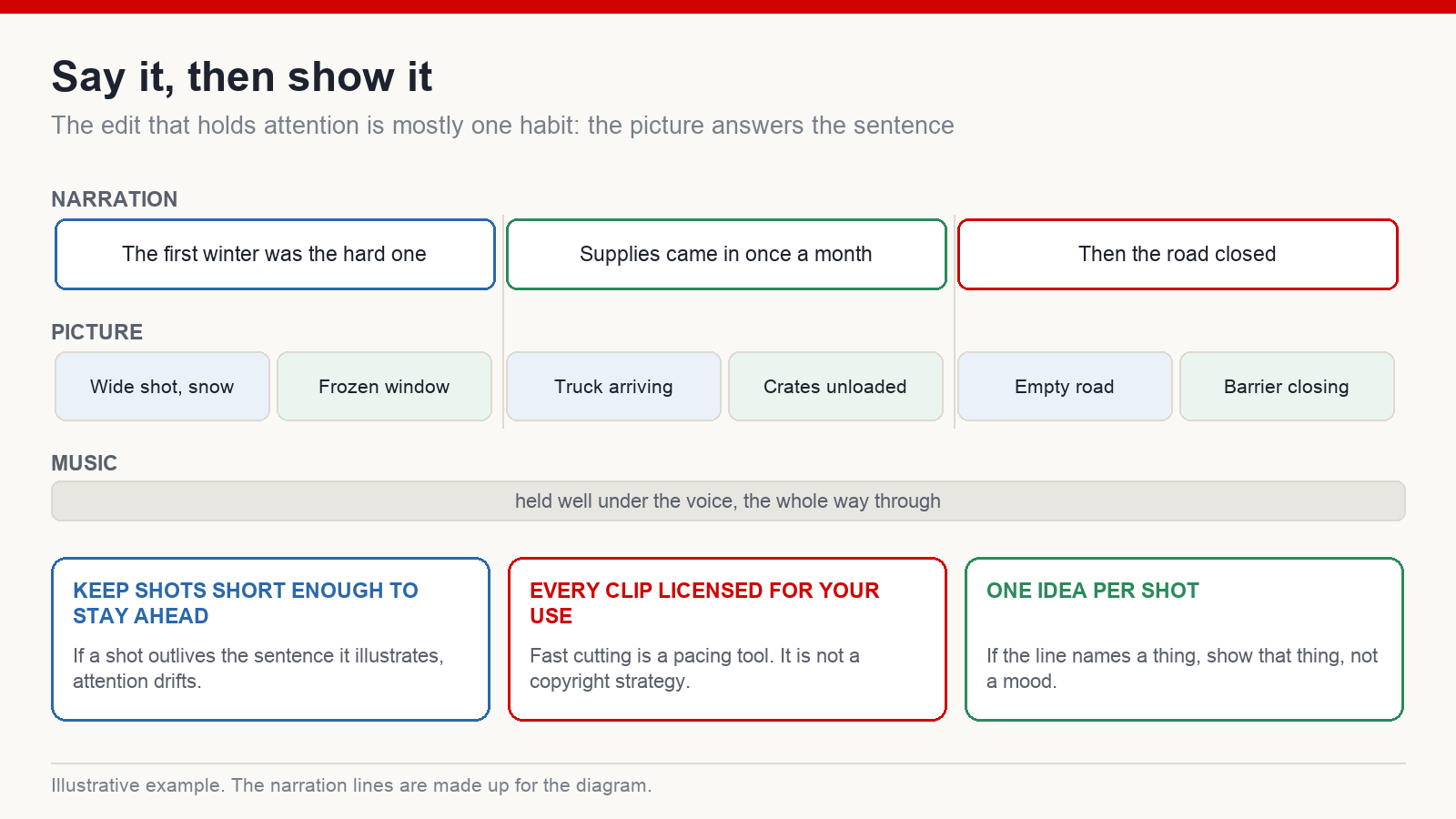
You do not need to become a professional editor. Free tools do everything a faceless channel needs, and the difference between a video that holds people and one that does not is rarely software.
It is three habits.
Show what you just said. If the narration names a person, a place or an object, the picture should be that person, place or object – not an abstract mood shot. When sound and image agree, the viewer processes the information without effort. When they disagree, the viewer starts working, and working is what makes people leave.
Do not let a shot outlive its sentence. Short clips keep the picture moving with the script. Treat that as a pacing tool and nothing else – fast cutting does not make someone else’s footage yours, and it will not protect you if you are using material you do not have the rights to. Every clip in your timeline should be something you licensed, generated, or shot.
Keep the music underneath. Background music has one job: to fill silence. If it competes with the narration at any point, it is too loud. When in doubt, set it lower than feels right.
3. Reading the market before you make anything
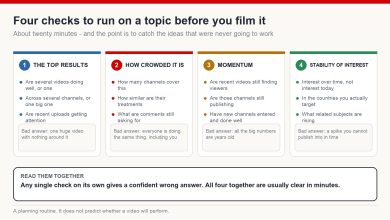
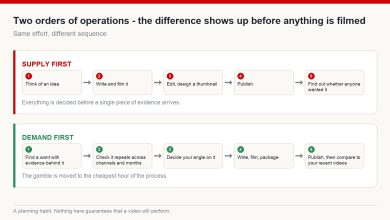
Most beginners build the video first and go looking for an audience afterwards. People who have done this a while do the reverse, and it is the single biggest difference in outcomes I see.
The research is not complicated:
- Open the Popular tab on five or six channels in your subject and sort by views. You are looking for what audiences chose, not what those creators intended.
- Find the repeat. If four unrelated channels each have an outlier that is essentially the same idea in different packaging, that idea is demand, not coincidence.
- Prefer subjects with moderate search interest over the biggest ones. A new channel competing for the broadest terms is competing with everyone; a narrower angle gives the algorithm something specific to match you to.
- Do the unglamorous setup work – a channel description that says what the channel is, titles written for a human rather than a keyword list, clear video descriptions, chapters on longer videos.
4. Writing the first line
A good video that opens badly is an unwatched video. The opening has to promise something specific within a handful of seconds, and then keep that promise.
The promise part is easy to get wrong in a way that punishes you later. An opening that overstates – a startling number, a claim you cannot support – buys attention for fifteen seconds and loses it at forty when the video fails to deliver. Retention graphs make that trade very visible.
What works is concrete tension: a thing that should not be true, a decision with a cost, a question the viewer already half-holds. “This road only exists for two months of the year” gets people to stay because the video can actually pay it off.
The same restraint applies to calls to action. One short, natural line beats a scripted appeal, and a question people genuinely want to answer will do more for a comment section than asking for comments will.
5. Studying structure before inventing your own
Everyone wants to be original. Originality before you understand the format usually just means learning slowly.
For your first stretch of videos – call it the first hundred – treat published work as material to study. Take a video that performed unusually well in your niche and break it down: where the hook lands, how long before the first turn, how often the picture changes, what the middle does to keep you there, how it ends.
Then build your own video on that skeleton with your own subject, your own research and your own assets. That is the line, and it matters: you can borrow the shape of a video, never the footage, script or voice track. Re-uploading or lightly repackaging other people’s material breaks platform rules and can cost you the channel.
Once the structure is second nature, personal style arrives on its own. It tends to show up in the details – your pacing, the kind of examples you reach for, what you refuse to do.
What it costs to start
Less than people expect. A basic computer, a small monthly software budget for a writing assistant, a voice tool and a stock licence, and you have a working production line. Set that against the cost of a studio or a team and it is a modest commitment.
The real cost is not money. It is the fifty or so videos you make while you are still bad at all five of these skills, and whether you are willing to keep going through the stretch where the numbers do not reward you yet. That is the part that filters people, and no tool removes it.
Can a complete beginner run a faceless channel?
Yes. Nothing here requires prior industry experience – it requires a process and enough repetitions to get through the clumsy stage. Expect the first videos to be poor; that is the cost of entry, not a signal to quit.
Do I need to speak the language of my audience?
Not fluently, but you need quality control. Voice tools handle the narration, but you should have a native speaker review scripts and pronunciation before publishing, and follow platform requirements on disclosing synthetic voice.
Do I need expensive equipment?
No. A modest computer and a handful of subscriptions cover it. Spend on stock footage and research time before you spend on hardware.
How long until a channel earns anything?
There is no reliable answer, and anyone giving you a timeline is guessing. It depends on niche, output, quality and the audience you reach, and many channels never reach monetisation at all. Plan as though it will take much longer than you would like.
Which of the five should I work on first?
Market research, every time. Editing and scripting improve steadily with practice, but making a well-produced video that nobody was looking for is the most expensive mistake available to a beginner.
If you want the full process for building a channel aimed at an English-speaking audience, that is what I teach at mmoyoutube.com. Results vary between channels, and platform policies change – treat everything here as a way of working, not a guarantee of an outcome.